
How the VYT Player Rating Works
The full VYT Rating formula, explained: twelve weighted components, eco-adjusted kills, clutch odds, trade credit — and why a perfect flash finally counts.
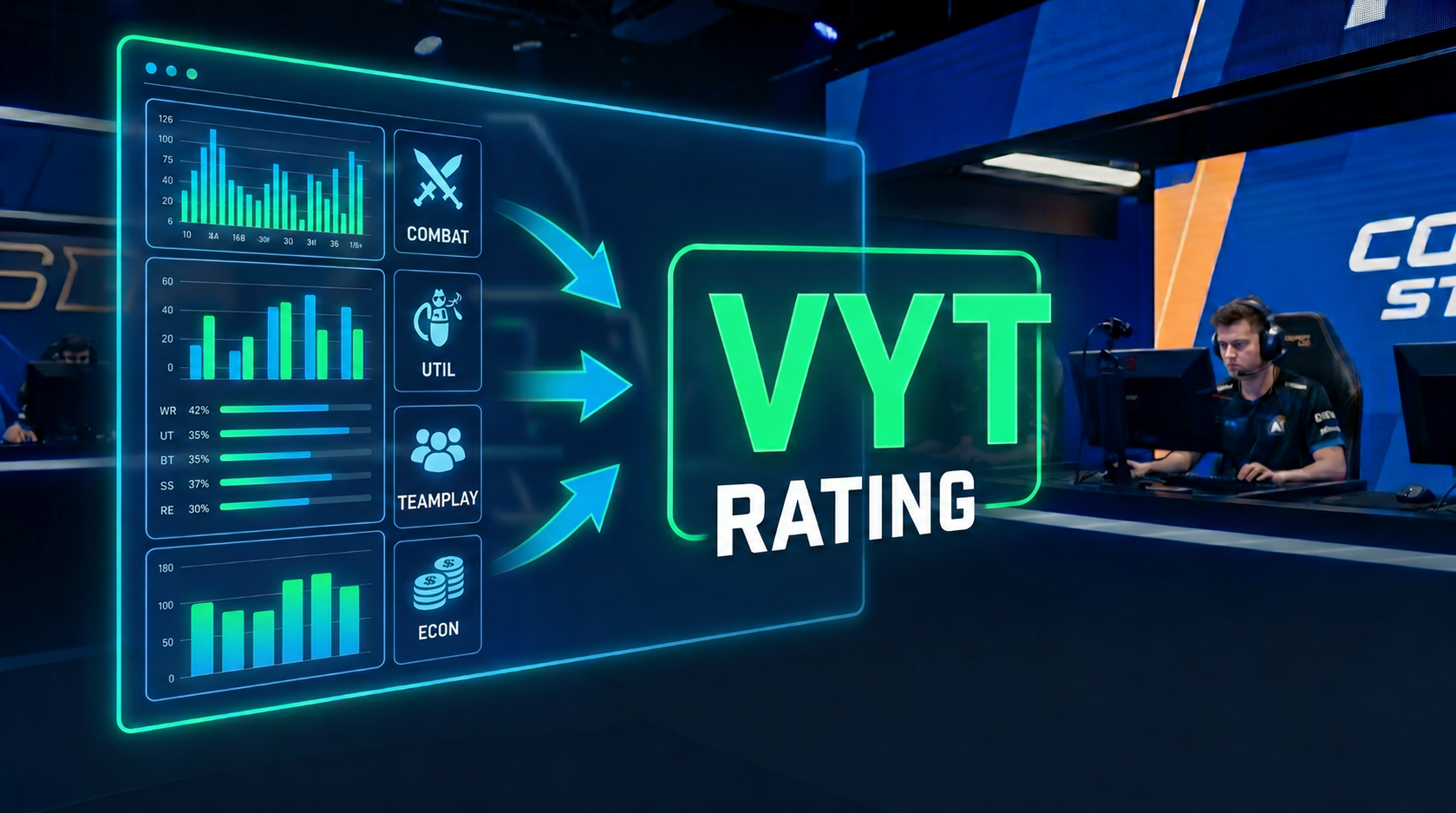
The core philosophy: every action counts
Most player ratings are kill counters with extra steps. Ours isn't. The VYT Rating is built on one principle: everything a player does for their team should move the number — the entry frag, obviously, but also the flash that made it possible, the smoke damage that broke the eco, the death that baited a trade, the plant in a round that was already lost.
A rating of 1.00 is exactly league average. Every stat is measured as a deviation from what an average professional does per round, multiplied by a weight that reflects how much that action contributes to winning. Play an average match and every component contributes zero. Outperform in any area — even a "soft" one like flash support — and your rating rises. There is no black box: the full formula is below, weights and all.
How to read the scale
1.30+ — a dominant performance, usually the best player on the server. 1.10–1.30 — a strong, match-winning showing. 0.90–1.10 — did their job. 0.75–0.90 — a quiet map. Below 0.75 — a rough one. Ratings are computed per map from the official demo, then shown per map and aggregated per match.
The formula
Rating = 1.00 + Σ weight × (your value − league baseline)
Twelve components, grouped into four blocks. All values are per round unless stated otherwise.
Block 1: The core (the biggest share)
Firepower — weight 0.55
Eco-adjusted kills per round, against a baseline of 0.65. Eco-adjusted means a kill against a team on an eco buy counts as 70% of a kill — mowing down pistols simply proves less than winning rifle duels. This is something most ratings ignore entirely.
Survival — weight 0.50
Eco-adjusted deaths per round, inverted, against the same 0.65 baseline. Dying on your own team's eco round is discounted to 75% of a death — you were sent out with a pistol; the rating shouldn't pretend that was a fair fight you lost.
Damage — weight 0.25
ADR (average damage per round) against a baseline of 74. Damage is capped at the victim's remaining health — no inflated numbers from "111 in 1" AWP shots — and only damage to enemies counts.
Consistency — weight 0.005 per percentage point
KAST: the share of rounds where you contributed a Kill, Assist, Survived, or were Traded. Baseline 70%. This is the "showed up every round" metric — it separates streaky players from reliable ones.
Block 2: Impact
Opening duels — weight 0.15
First kills minus first deaths, per round. The opening pick is the single most round-deciding event in CS2, so winning your entries matters more than your total kill count suggests.
Multi-kills — weight 0.12
Multi-kill rounds converted to points: a 2k is worth 1, a 3k is 2, a 4k is 4, an ace is 7 — measured against a baseline of 0.17 points per round. Four kills spread over four rounds is good; four kills in one round wins it on the spot.
Clutches — weight 0.45
Won clutches, weighted by the odds you beat: a 1v1 win is 0.5 points, scaling up to 2.5 for a 1v5. Lost clutch attempts are not punished — you were already left in the worst spot on the team, and the death is counted in the survival component anyway.
Block 3: Teamplay and utility
Trade participation — weight 0.07
Trade kills (you avenged a teammate within five seconds) plus traded deaths (your death was avenged), against a baseline of 0.26 per round. A traded death is a team-positive death — it means you played positions where your team could punish. Lurkers who die alone in the back of the map don't get this credit.
Utility damage — weight 0.05
Damage dealt with grenades and molotovs, baseline 3.5 per round.
Enemies flashed — weight 0.045
The number of enemies you meaningfully blinded (at least half a second), baseline 0.50 per round.
Enemy blind time — weight 0.025
The total seconds of blindness you inflicted on enemies, baseline 1.5 seconds per round. Together with enemies flashed, this is how support players finally get paid: a perfectly timed pop-flash that wins the round but earns no kill, no assist, and no damage is invisible to a classic rating. Not to this one.
Block 4: Objectives
Plants and defuses — weight 0.09
Bomb plants plus defuses, baseline 0.07 per round. Planting converts a round into ticking pressure and a potential save; defusing literally wins it. Both are routinely done by the players with the least glamorous stat lines.
What the rating deliberately ignores
No style points. AWP kills, no-scopes, wallbangs and smoke kills are tracked and displayed, but they don't carry extra rating weight — a kill is a kill, and a flashy one isn't worth more rounds. There is also no bonus for simply being on the winning team: the rating measures your contribution, not your team's scoreline.
Where the numbers come from
Match data flows in from several sources: official platform providers, official tournament and league APIs, and — for the deepest level of detail — the official match demos, the same files used for anti-cheat review. Demo-derived stats are held to strict standards: damage is health-capped, team damage is excluded, and side-by-side scores (CT/T splits, overtime) are tracked per map. The rating is fully deterministic: the same data always produces the same number.
How it compares to HLTV
HLTV's rating is an excellent kill-economy model, and on pure fraggers the two systems mostly agree. The difference shows at the edges. A support player who throws 20+ effective flashes a map will rate visibly higher with us than on HLTV. An entry who feasts on eco rounds will rate slightly lower. We think both corrections are honest — and unlike other ratings, you can check every weight in this article against your own math.